Table of contents Food StampWork Requirement Expansion: Complete 2026 Guide to SNAP Rules, Age Limits & Exemptions Quick Facts What Is This Program? Who Qualifies? Who Does NOT Qualify for Exemption Common Exceptions Income Examples Real-Life Situations Income Limits Income and the Work Requirement Asset Limits Household Requirements Living Arrangements and Work Requirements Citizenship…
Table of contents
Food Stamp Work Requirement Expansion: Complete 2026 Guide to SNAP Rules, Age Limits & Exemptions
The food stamp work requirement expansion raises the SNAP work rule age from 55 to 64, requires able-bodied adults without dependents to complete 80 hours per month of work, training, or volunteering, and limits non-compliant recipients to three months of benefits in a three-year period. Exemptions for veterans, homeless individuals, and former foster youth were eliminated. Implementation began November 1, 2025, with first benefit losses in 2026.
USDA Food and Nutrition Service (FNS); administered by state human services agencies
Eligibility
Able-bodied adults ages 18–64 without dependents under 14 must meet work requirements
Income Limits
Gross monthly income at or below 130% of federal poverty level (e.g., $1,729 for household of 1)
Monthly Benefit
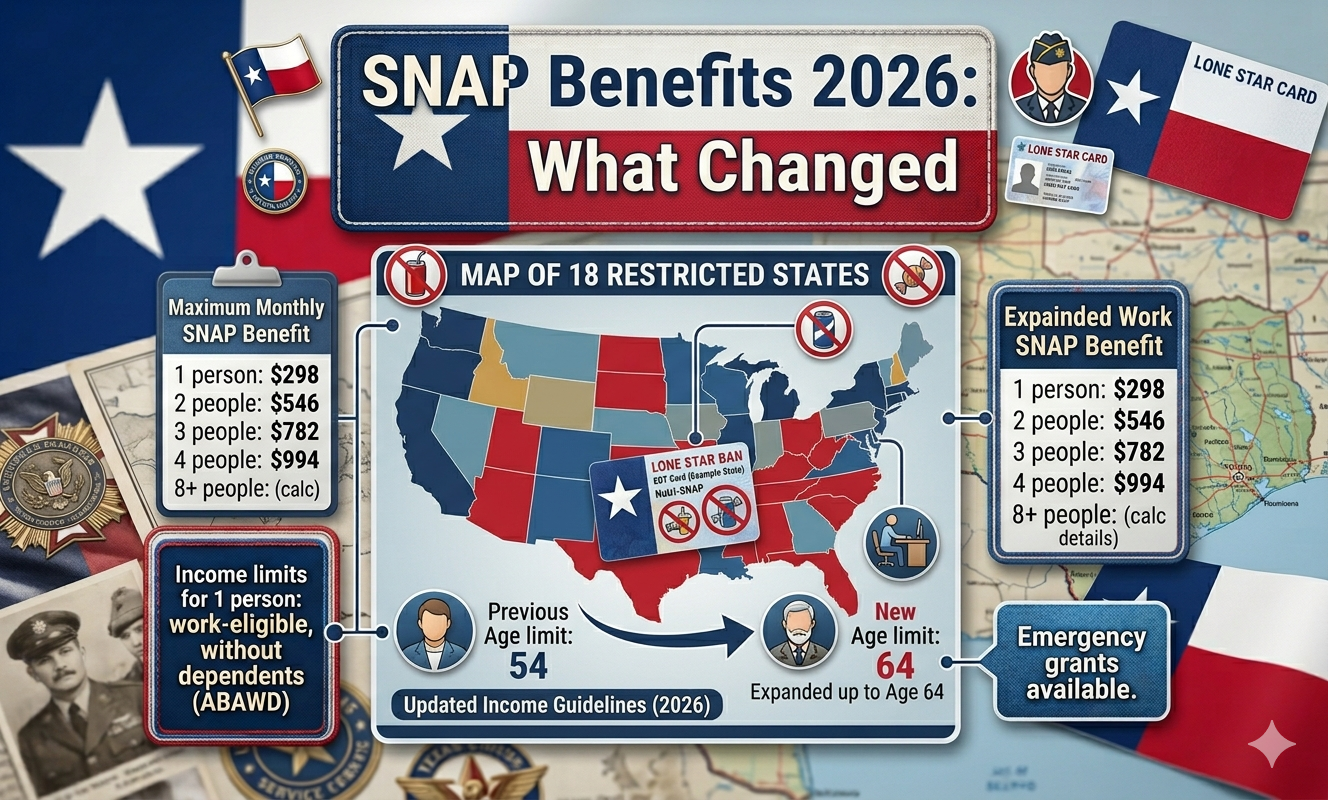
Maximum $298 for household of 1; $546 for 2; $785 for 3; $994 for 4 (48 states, FY2026)
Application
State SNAP office, online portal, phone, or in person
Processing Time
30 days standard; 7 days expedited
Renewal
Recertification every 12 months (varies by state); interim reports required
Available States
All 50 states, D.C., Guam, Virgin Islands
Last Updated
October 2026
What Is This Program?
The food stamp work requirement expansion refers to changes made to the Supplemental Nutrition Assistance Program (SNAP) by the One Big Beautiful Bill Act (OBBBA), signed into law on July 4, 2025. These changes significantly expanded the existing Able-Bodied Adult Without Dependents (ABAWD) work requirement, which previously applied only to adults ages 18–54 without dependents. Under the expansion, the requirement now covers adults ages 18–64 who do not live with a child under age 14 and are physically and mentally able to work.
SNAP is the nation’s largest federal food assistance program, serving approximately 42 million Americans monthly. The program provides monthly benefits on an EBT card that can be used to purchase food at authorized retailers. The work requirement expansion is part of a broader overhaul of SNAP that also includes changes to noncitizen eligibility, administrative cost-sharing, and benefit calculations.
The expansion represents the most significant change to SNAP work rules since the 1996 welfare reform law. Prior to the OBBBA, the ABAWD time limit applied to adults ages 18–54. The new law raises the upper age limit to 64, meaning millions of additional SNAP recipients are now subject to the work requirement and its three-month time limit.
Who Qualifies?
To be subject to the expanded SNAP work requirement — and therefore potentially lose benefits for non-compliance — you must meet all of the following criteria:
Age requirement: You must be between 18 and 64 years old. Individuals age 65 or older are exempt.
Dependency status: You must not live in a household with a child under age 14. If you have a dependent child under 14 living with you, you are exempt from the work requirement. The age threshold was lowered from 18 to 14, meaning parents with children ages 14–17 are no longer automatically exempt.
Work capability: You must be physically and mentally able to work. If you have a verified disability or medical condition that prevents you from working 20 hours per week, you may qualify for an exemption.
ABAWD status: You must be an “able-bodied adult without dependents” under the expanded definition. This now includes adults ages 55–64 without dependents and adults with children in the home when the youngest child is age 14 or older.
Who Does NOT Qualify for Exemption
The following groups lost automatic exemptions under the OBBBA:
Veterans: Previously exempt from SNAP work requirements, veterans are now subject to the 80-hour rule unless they meet another exemption
People experiencing homelessness: The homeless exemption was eliminated effective November 1, 2025
Former foster youth: Young adults ages 18–24 who transitioned out of foster care lost their exemption
Caregivers of children ages 14–17: The dependent child exemption now applies only to children under 14
Common Exceptions
You may still be exempt from the work requirement if you:
Are under 18 or 65 or older
Are pregnant
Have a physical or mental health condition that prevents you from working 20 hours per week
Senior receiving SSI: A 67-year-old SSI recipient is not subject to the SNAP work requirement because they are over 64. SSI recipients generally qualify for SNAP and are exempt from work rules.
Disabled worker: A 50-year-old receiving SSDI for a back injury is exempt from the SNAP work requirement because they receive disability benefits. They must provide proof of SSDI receipt.
College student: A student enrolled at least half-time is generally exempt from the ABAWD work requirement, though different rules may apply to students in higher education. Students should verify their status with their state SNAP office.
Single mother with young child: A mother with a child under 14 is exempt from the work requirement. If her youngest child is 14 or older, she becomes subject to the 80-hour rule.
Veteran experiencing homelessness: A veteran who is homeless is now subject to the work requirement because both the veteran and homeless exemptions were eliminated. They must meet the 80-hour rule or qualify for another exemption.
Retired couple: A married couple both over 65 is exempt from the work requirement. If one spouse is under 65 and able-bodied, that spouse may be subject to the requirement.
Income Limits
SNAP income limits are set at 130% of the federal poverty level for gross monthly income. For FY2026 (October 1, 2025 – September 30, 2026), the gross monthly income limits are:
Household Size
Gross Monthly Income Limit (130% FPL)
1
$1,729
2
$2,336
3
$2,943
4
$3,550
5
$4,157
6
$4,764
7
$5,371
8
$5,978
Households with a member who is 60 or older or has a disability may qualify under different income rules, often using net income rather than gross income standards.
Income and the Work Requirement
Meeting the SNAP income limit is separate from meeting the work requirement. You can qualify for SNAP based on income but still be subject to the work requirement. The 80-hour rule applies regardless of your income level if you are an ABAWD.
Asset Limits
Most SNAP households are not subject to an asset test. However, households that include a member who is 60 or older or has a disability may have an asset limit of $3,500 (or $4,500 if the household includes a member with a disability or is 60+).
Households with income below the 200% poverty level may qualify for “expanded categorical eligibility” in some states, which eliminates the asset test entirely. Check with your state SNAP office for specific asset rules.
Household Requirements
SNAP defines a household as everyone who lives together and purchases and prepares meals together. This includes spouses and children under 22 who live together. For SNAP eligibility, household size determines income limits and benefit amounts.
Living Arrangements and Work Requirements
Living Arrangement
Effect on Work Requirement
Living alone, no dependents
Subject to ABAWD work rule if age 18–64
Living with child under 14
Exempt from work requirement
Living with child 14+
Subject to work requirement
Living with spouse who is disabled
May qualify for exemption as caregiver
Living with parents (adult child)
Work requirement may still apply
Living in a treatment facility
Exempt if in substance use treatment
Citizenship Rules
To receive SNAP, you must be a U.S. citizen, U.S. national, or a qualified non-citizen. The OBBBA also restricted noncitizen eligibility for SNAP. Many lawfully present immigrants may have lost benefits due to new restrictions.
Immigration Eligibility
SNAP eligibility for non-citizens depends on immigration status:
U.S. citizens and nationals: Eligible if income requirements are met
Lawful permanent residents (LPRs): May be eligible after a waiting period or if they meet specific criteria
Refugees and asylees: Generally eligible for a limited period
Other qualified non-citizens: May be eligible depending on status
Undocumented immigrants: Not eligible for SNAP
Non-citizens must provide proof of their immigration status when applying. The OBBBA made changes to noncitizen eligibility that may affect lawfully present immigrants who previously received benefits.
State Differences
Implementation of the expanded work requirements has been phased in state by state rather than on a single national date. Key state differences include:
States with Delayed Implementation
Some states received waivers or extensions due to litigation or high unemployment rates. The hold-harmless period for implementation was extended until April 9, 2026, for 21 states as a result of a lawsuit filed in November 2025.
States with Active Waivers
Waivers are now limited to areas with unemployment rates above 10%, with exceptions for Alaska and Hawaii through 2028. California’s waiver is scheduled to remain in place until January 2027.
State Implementation Timeline
State
Implementation Date
Illinois
February 1, 2026
New York
March 1, 2026
Most states
November 1, 2025 – March 1, 2026
States with waivers
Varies (California until January 2027)
States Without Work Requirement (Waiver)
As of 2026, states that have received time-limit waivers include Alaska, Arizona, California, Colorado, Connecticut, Delaware, District of Columbia, Kentucky, Illinois, Maine, Michigan, Minnesota, Montana, Nevada, New Hampshire, and New Jersey, among others.
State Supplements and Additional Support
Some states offer additional support for SNAP recipients subject to work requirements, including job training, volunteer placement assistance, and expanded exemption categories. Illinois, for example, has directed its Department of Human Services to help SNAP recipients understand and comply with the new work requirements and pursue appropriate federal waivers where available.
Required Documents
To apply for SNAP and verify compliance with work requirements, you will need:
Identity and household documents:
Government-issued photo ID
Social Security numbers for all household members
Proof of residency (lease, utility bill, etc.)
Proof of citizenship or immigration status
Income documents:
Pay stubs from the past 30 days
Employer letters
Self-employment records
Unemployment benefit statements
Work requirement documentation:
Pay stubs or timesheets showing 80 hours per month
Medical expense records (for households with elderly or disabled members)
How to Apply
There are several ways to apply for SNAP:
Online: Most states have online application portals. Visit your state’s SNAP website or Benefits.gov to find the application link.
By phone: Contact your state SNAP office to apply by phone or schedule an interview.
In person: Visit your local Department of Social Services or Human Services office.
By mail: Request a paper application from your state agency.
Step-by-Step Guide
Gather documents listed above before applying
Complete the application online, by phone, or in person
Participate in an eligibility interview — usually by phone
Provide verification documents within 10 days of request
Receive determination within 30 days (or 7 days for expedited benefits)
Report compliance with work requirements monthly or at recertification
Online Application
Most states offer online SNAP applications. You can:
Create an account on your state’s benefits portal
Complete and submit the application
Upload supporting documents
Track your application status
Report changes and recertify
Benefits.gov provides a prescreening tool to check potential eligibility before applying. The USDA’s SNAP State Directory at fns.usda.gov/snap/state-directory lists contact information for every state SNAP office.
Processing Time
SNAP applications are processed within 30 days of submission for standard applications. Households that meet expedited service criteria — those with very low income and resources — must receive benefits within 7 days.
Application Type
Processing Time
Standard
30 days
Expedited
7 days
Recertification
30 days before expiration
Payment Schedule
SNAP benefits are issued monthly on an EBT (Electronic Benefits Transfer) card. The specific day of the month varies by state and is typically based on the recipient’s case number or last name.
State
Benefit Issuance Days
California
1st–10th
New York
1st–9th
Texas
1st–15th
Florida
1st–28th
Illinois
1st–20th
Benefits are available for use as soon as they are loaded onto the EBT card. There is no set payment schedule like SSI — SNAP benefits are loaded according to your state’s schedule.
Renewal Process
SNAP certification periods vary by state but are typically 12 months. At renewal, you must:
Complete a recertification application before your certification period ends
Participate in an interview (often waived for some households)
Provide updated income and expense documentation
Verify continued compliance with work requirements
If you are subject to the ABAWD work requirement, you must report your work hours and activities at application, recertification, and when your circumstances change. Failure to report can result in loss of benefits.
Reporting Requirements
You must report within 10 days:
Changes in income
Changes in household size
Changes in address
Changes in work hours (if subject to ABAWD rule)
Loss of exemption status
Reasons Applications Are Denied
SNAP applications may be denied for:
Income above limits: Gross monthly income exceeds 130% of the federal poverty level
Failure to attend interview: Not participating in the eligibility interview
Non-citizen status: Not meeting citizenship or immigration requirements
Failure to report changes: Not reporting required information
Intentional program violation: Fraud or misrepresentation
ABAWD-Specific Denials
If you are subject to the ABAWD work requirement and do not meet it or qualify for an exemption, you can only receive SNAP for three months in a three-year period. After those three months, you lose eligibility until you meet the work requirement or qualify for an exemption.
Appeals Process
If your SNAP application is denied or your benefits are reduced or terminated, you have the right to appeal. The process varies by state but generally follows this structure:
Request a fair hearing within 90 days of the notice (some states have shorter deadlines)
Continue receiving benefits if you request a hearing before the effective date of the action (in most cases)
Present your case at an administrative hearing
Receive a decision from the hearing officer
Appeal further to state or federal court if needed
You can request a fair hearing by contacting your state SNAP office. You have the right to represent yourself or have someone represent you.
Common Mistakes
Not reporting work hours: Failing to document and report 80 hours per month leads to benefit loss
Assuming veteran status exempts you: Veterans are no longer automatically exempt
Assuming homelessness exempts you: The homeless exemption was eliminated
Not providing proof of exemption: If you qualify for an exemption, you must document it
Missing recertification deadlines: Failure to recertify on time can cause a gap in benefits
Not reporting changes in household composition: A new child under 14 could exempt you
Waiting until benefits are lost to act: Contact your state office as soon as you receive a notice
Not seeking available exemptions: Many people may qualify for exemptions they don’t know about
Recent Changes
The OBBBA made several changes to SNAP effective in 2025–2026:
Expanded ABAWD age range: Raised from 18–54 to 18–64
Dependent child exemption narrowed: Lowered from under 18 to under 14
Veteran exemption eliminated: Veterans are now subject to work requirements
Homeless exemption eliminated: People experiencing homelessness are now subject to work requirements
Former foster youth exemption eliminated: Ages 18–24 who aged out of foster care are now subject
Waiver criteria tightened: Geographical waivers now limited to areas with unemployment above 10%
Administrative cost share increased: States now pay 75% of administrative costs (up from 50%), starting October 1, 2026
Benefit cost sharing begins 2027: States with high payment error rates will pay up to 15% of benefit costs starting October 1, 2027
Frequently Asked Questions
1. What are the new SNAP work requirements for 2026? Able-bodied adults ages 18–64 without dependents under 14 must complete 80 hours per month of work, training, or volunteering. Non-compliant recipients are limited to three months of benefits in a three-year period.
2. What age does the SNAP work requirement apply to in 2026? The work requirement now applies to adults ages 18 through 64. Previously, it applied only to adults ages 18–54. The age limit was raised from 55 to 64 under the OBBBA.
3. Are veterans exempt from SNAP work requirements? No. Effective November 1, 2025, the veteran exemption was eliminated. Veterans are now subject to the 80-hour work requirement unless they qualify for another exemption, such as disability.
4. Are homeless individuals exempt from SNAP work requirements? No. The homeless exemption was also eliminated effective November 1, 2025. People experiencing homelessness must meet the work requirement or qualify for another exemption.
5. How many hours do I need to work to keep SNAP benefits? You must complete at least 80 hours per month (about 20 hours per week) of qualifying activities: paid work, unpaid work, job training, education, or volunteering.
6. What happens if I don’t meet the SNAP work requirement? You can only receive SNAP benefits for three months in a three-year period. After those three months, you lose eligibility until you meet the work requirement or qualify for an exemption.
7. Can I volunteer to meet the SNAP work requirement? Yes. Volunteering with an approved organization can count toward the 80-hour requirement. Contact your state SNAP office for a list of approved volunteer placements.
8. What if I have a disability — am I exempt? Yes. If you have a physical or mental health condition that prevents you from working 20 hours per week, you may qualify for an exemption. You must provide medical documentation.
9. Is the SNAP work requirement the same in every state? No. Implementation timelines and waiver status vary by state. Some states received extensions and are implementing the requirements later than others.
10. Can I go to school to meet the work requirement? Yes. Participating in an approved education or training program for at least 80 hours per month can satisfy the requirement. You must be enrolled at least half-time in an approved program.
11. What happens if I lose my job and can’t meet the 80-hour rule? You should report your change in circumstances immediately. You may qualify for an exemption or be eligible for a three-month period of benefits while you seek new employment.
12. Does the work requirement apply to parents? Parents with a child under 14 in the home are exempt. Parents with a youngest child age 14 or older are subject to the requirement.
13. How do I prove I’m meeting the work requirement? Submit pay stubs, timesheets, employer letters, training enrollment records, or volunteer verification letters to your state SNAP office.
14. What states have not implemented the new work requirements yet? Several states have waivers or extended implementation timelines, including California (waiver until January 2027), Alaska, Hawaii, and others with high unemployment areas.
15. Will I lose SNAP if I don’t report my work hours? Yes. Failure to report work hours or provide documentation can result in termination of benefits. Report all work activities at application, recertification, and within 10 days of any change.
Key Takeaways
Expanded age range: SNAP work requirement now applies to ages 18–64, up from 18–54
80-hour rule: Must complete 80 hours per month of work, training, or volunteering
Three-month limit: Non-compliant recipients limited to 3 months of benefits in 3 years
No veteran exemption: Veterans are no longer automatically exempt
No homeless exemption: People experiencing homelessness are no longer exempt
Dependent child threshold lowered: Exemption now applies only to children under 14
State implementation varies: Timelines differ; some states have waivers
Medicaid link: SSI recipients generally qualify for Medicaid in most states
Documentation required: Must provide proof of work hours or exemption status
Appeal rights: You can appeal benefit reductions or terminations
Related Government Benefits
If you receive SNAP or are affected by the work requirement expansion, you may also qualify for:
Medicaid: Health coverage for low-income individuals. Many SNAP recipients qualify.
SSI (Supplemental Security Income): Cash assistance for aged, blind, or disabled individuals with limited income.
Introduction to the USDAFood and Nutrition Administration The USDA Food and Nutrition Administration (FNA) plays a pivotal role in addressing food security and nutrition across the United States. Established under the United States Department of Agriculture (USDA), the FNA strives to improve the nutritional wellbeing of individuals and families, particularly those facing economic hardships….
SSIFederal Benefit Rates 2026: How Much Will You Receive This Month? Instant Answer: Your SSI Payment Amount for 2026 The maximum Federal Benefit Rate (FBR) for SSI in 2026 is $994 per month for an individual** and **$1,491 per month for a couple . If you live in a state that adds its own supplement, your…
SSI Application Form Online: Complete 2026 Guide to Apply for Supplemental Security Income You can apply for Supplemental Security Income (SSI) online at SSA.gov if you are age 18 to 64 and 10 months, applying for both SSI and SSDI, a U.S. citizen, never married, and have never applied for SSI. Most other applicants must call 1-800-772-1213…