Social Security Trust Fund Depletion: What It Means for Your Benefits
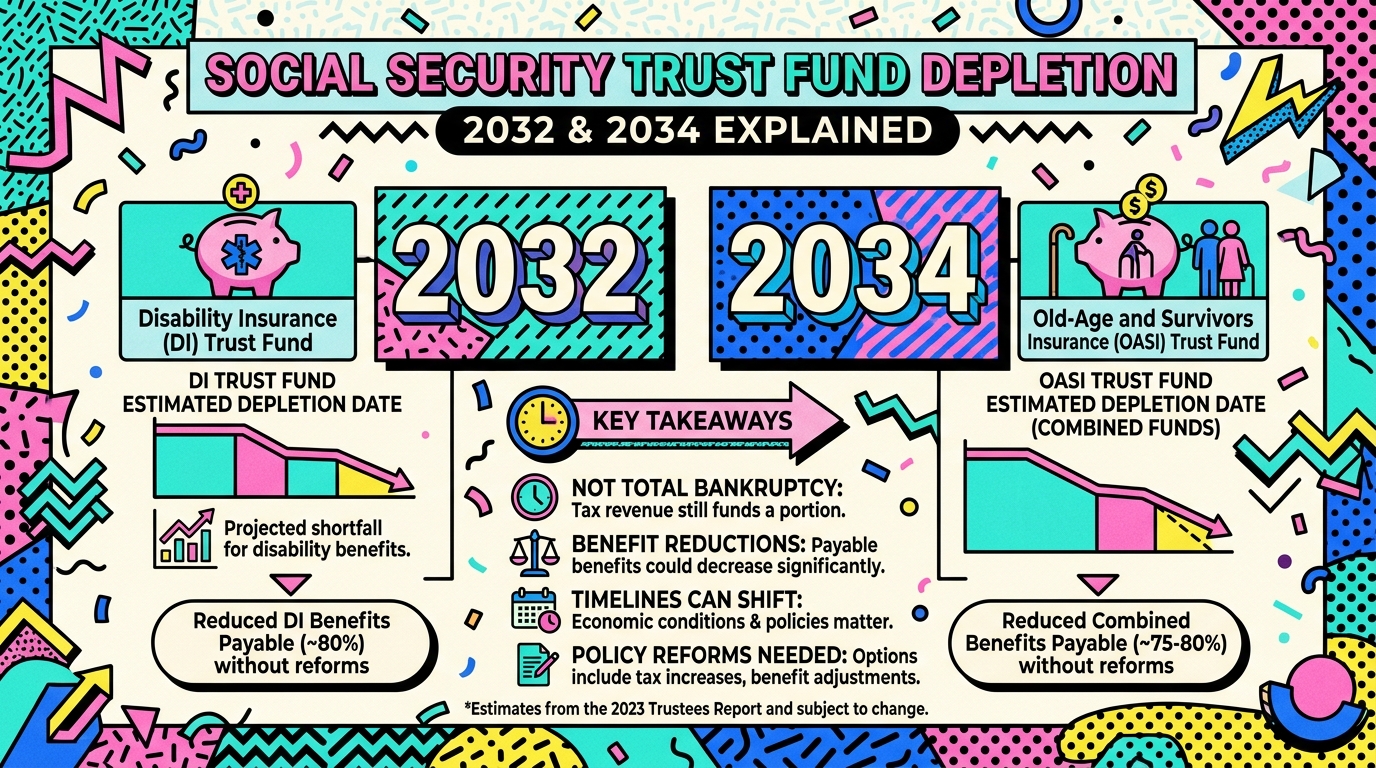
The Social Security Trust Fund is projected to be depleted in 2032 for retirement and survivors benefits (OASI) and 2034 for the combined trust funds. Depletion does not mean the program ends. Payroll tax revenue would still cover about 78% of scheduled OASI benefits or 83% of combined benefits, unless Congress acts sooner.
Quick Facts
Item
Information
Program
Social Security (Old-Age and Survivors Insurance and Disability Insurance)
40 work credits (10 years) for retirement; disability and survivor rules vary
Income Limits
No income limit for retirement eligibility; payroll tax applies to earnings up to $184,500 in 2026
Monthly Benefit
Average retirement benefit: $2,071 in 2026; average SSDI: about $1,630; maximum: $4,152
Application
Online at SSA.gov, by phone at 1-800-772-1213, or at a local office
Processing Time
Retirement claims often 2–4 weeks online; disability claims typically several months
Renewal
Not required; benefits continue automatically once approved
Available States
All 50 states, District of Columbia, and U.S. territories
Last Updated
2026 OASDI Trustees Report, released June 9, 2026
What Is the Social Security Trust Fund?
The Social Security Trust Fund is the accounting mechanism that holds surplus payroll tax revenue and interest earned on that revenue, used to pay benefits when annual costs exceed annual income. It is not a bank account filled with cash sitting in a vault. The trust funds hold special-issue U.S. Treasury securities, which are backed by the full faith and credit of the federal government.
There are two separate trust funds:
OASI Trust Fund: Pays retirement and survivors benefits.
DI Trust Fund: Pays disability benefits.
When Social Security collects more in payroll taxes than it pays out in a given year, the surplus is credited to the trust funds. When costs exceed income, the trust funds redeem securities to make up the difference. In 2025, the combined trust fund reserves declined by $160 billion** to **$2.56 trillion.
The 2026 Trustees Report projects that OASI reserves will be depleted in the fourth quarter of 2032, one quarter earlier than projected last year. The DI Trust Fund is projected to remain solvent throughout the 75-year projection period ending in 2100. If the two funds were combined, reserves would last until the third quarter of 2034, with 83% of scheduled benefits payable at that time.
Important distinction: Depletion of the OASI trust fund does not mean Social Security disappears. It means the fund can no longer pay 100% of scheduled benefits from reserves plus incoming revenue. Payroll taxes would continue to flow in, covering most—but not all—of the cost.
When Will the Trust Fund Be Depleted?
Under the Trustees’ intermediate assumptions, the OASI Trust Fund is depleted in 2032, and the combined OASI and DI trust funds are depleted in 2034. The 2026 report moved the OASI date one year earlier than the 2025 report, largely because of changes in the “One Big Beautiful Bill Act” (OBBBA) that reduce projected revenue from taxation of Social Security benefits.
The Trustees also publish stochastic projections—thousands of simulations reflecting different economic and demographic outcomes. In 95% of those simulations, the depletion year falls between 2032 and 2039. That range shows the projection is not a single fixed date; it depends on birth rates, immigration, wage growth, inflation, and policy choices.
Fund
Projected Depletion
Share of Benefits Payable at Depletion
OASI (retirement and survivors)
Q4 2032
78%
DI (disability)
Not depleted through 2100
100%
Combined OASI + DI
Q3 2034
83%
Source: 2026 OASDI Trustees Report.
What Happens If the Trust Fund Runs Out?
If the trust fund is depleted, Social Security would continue paying benefits from ongoing payroll tax revenue, but the amount payable would drop to about 78% of scheduled OASI benefits or 83% of combined benefits under current projections. The Social Security Act does not specify exactly how benefits would be reduced, but the standard interpretation is that benefits would be paid on a proportional basis—every beneficiary would see a cut, not that some beneficiaries would be paid in full while others receive nothing.
That means a retiree scheduled to receive $2,071 per month could see roughly $1,615 per month after OASI depletion, based on the 78% figure. A disabled worker receiving $1,630 could be less affected because the DI fund is projected to remain solvent, but the combined-fund projection assumes transfers between the two funds would be permitted by law. Currently, the two funds are separate, and a change in law would be needed to combine them or transfer revenue between them.
What would NOT happen automatically:
Social Security would not stop sending checks entirely.
The program would not become “bankrupt” in the sense of having zero money.
Benefits would not automatically be reduced for current beneficiaries only; the reduction would apply across the board under the Trustees’ projections.
What would happen automatically:
Incoming payroll taxes and taxation of benefits would continue to flow into the trust funds.
The Treasury would have insufficient reserves to make full scheduled payments.
Congress would face pressure to act, because benefit cuts are politically unpopular and affect more than 70 million beneficiaries.
Who Is Affected by Trust Fund Depletion?
Everyone who receives or will receive Social Security benefits could be affected, including retirees, survivors, disabled workers, and their dependents. That is about 70 million beneficiaries at the end of 2025. The effects would not be limited to one group.
Retirees and survivors are directly affected by the OASI depletion date in 2032. Disabled workers are less immediately affected because the DI fund is projected to remain solvent, but the combined-fund picture matters if Congress allows transfers between the funds or if the DI fund’s outlook changes in future reports.
Future beneficiaries—people now in their 30s and 40s—are affected because the longer Congress waits, the larger the needed adjustment. The Trustees’ 75-year actuarial deficit is 4.42% of taxable payroll, up from 3.82% last year. That means closing the gap requires either higher revenue, lower benefits, or both.
Low-income beneficiaries may be disproportionately affected because Social Security represents a larger share of their retirement income. According to the Bipartisan Policy Center, the ratio of workers to beneficiaries has dropped from more than 5-to-1 in 1960 to 2.9-to-1 today, and is projected to fall to 2.2-to-1 by the 2070s. Fewer workers supporting more retirees is the core demographic pressure.
People who do not qualify for Social Security—such as some recent immigrants without sufficient work history—are not directly affected by trust fund depletion, but they may rely on SSI, which is financed through general federal revenues, not the trust funds. SSI is a separate needs-based program administered by SSA.
How Social Security Is Funded
Social Security is funded primarily through a 12.4% payroll tax on wages up to the taxable maximum ($184,500 in 2026), split evenly between employees and employers. Self-employed workers pay the full 12.4%. Revenue also comes from federal income taxation of Social Security benefits and interest earned on trust fund reserves.
In 2025:
Net payroll tax contributions: $1.32 trillion
Income taxation of benefits: $58 billion
Interest: $69 billion
Total income: $1.45 trillion
Total expenditures: $1.61 trillion
Social Security’s cost has exceeded its non-interest income since 2010, and total cost began exceeding total income in 2021. The program is now paying out more than it takes in from taxes alone, drawing on reserves and interest to make up the difference.
The taxable maximum is adjusted annually for growth in the national average wage index. Because wages for higher earners have grown faster than the cap, the share of covered earnings subject to payroll tax has fallen from about 90% in 1983 to 83% today. That erosion of the tax base is one reason the long-range shortfall has grown.
Why the Trust Fund Is Depleting
The trust fund is depleting because the number of beneficiaries is growing faster than the number of workers paying payroll taxes, and because benefit costs are rising while the tax base has not kept pace. Three demographic and economic factors drive the projection:
1. An aging population. The large baby boom generation has moved into retirement. The worker-to-beneficiary ratio has fallen sharply and is projected to continue falling.
2. Lower fertility and immigration assumptions. The 2026 Trustees Report lowered the assumed ultimate total fertility rate from 1.90 to 1.75 children per woman and reduced projected net immigration. Those changes mean fewer future workers, lower taxable payroll, and lower GDP over the long range.
3. Policy changes that reduce revenue. The One Big Beautiful Bill Act, enacted July 4, 2025, made permanent lower ordinary income tax rates and larger standard deductions. Those changes are projected to reduce revenue from income taxation of Social Security benefits flowing into the trust funds.
The 75-year shortfall is now estimated at approximately **$30 trillion**, up from $26 trillion last year. The actuarial deficit of 4.42% of taxable payroll means that closing the gap would require the equivalent of raising the payroll tax rate by 4.42 percentage points, cutting benefits by a comparable amount, or some combination of the two—phased in over time.
What Has Congress Done?
Congress last enacted major Social Security financing reform in 1983. The 1983 Amendments gradually raised the full retirement age from 65 to 67, subjected a portion of Social Security benefits to federal income taxation, and increased payroll tax revenue. Those changes were designed to keep the program solvent for the next 75 years, and they produced large trust fund surpluses in the following decades.
Since then, Congress has made smaller changes but has not addressed the long-range imbalance. The Social Security Fairness Act, signed into law on January 5, 2025, repealed the Windfall Elimination Provision (WEP) and Government Pension Offset (GPO), effective for benefits payable for January 2024 and later. That law restored full Social Security benefits for many public-sector workers, teachers, police officers, and firefighters who also receive pensions from non-Social Security-covered employment.
The PROMISE Act of 2026 and a related Senate resolution would establish a process for developing solvency recommendations, but as of this writing they have not been enacted into law. The Social Security 2100 Act and the Social Security Expansion Act are other proposals that would increase revenue by applying payroll taxes to higher earnings, but neither has passed.
Reform Options Under Discussion
Lawmakers have a wide range of options to close the financing gap, but no single approach has enough support to become law yet. The Trustees describe three broad categories:
Approach
Examples
Trade-offs
Increase revenue
Raise payroll tax rate; raise or eliminate taxable maximum; dedicate other revenue
Higher taxes on workers and employers; may reduce take-home pay or employment
Reduce benefits
Change benefit formula; raise full retirement age further; reduce cost-of-living adjustments
Lower monthly benefits or later claiming; may reduce retirement security
Combination
Modest tax increases plus modest benefit changes, phased in gradually
Spreads adjustment across generations; requires political compromise
Source: 2026 OASDI Trustees Report.
The Trustees recommend addressing the shortfall sooner rather than later so that changes can be phased in gradually and workers and beneficiaries have time to adjust. Waiting increases the size of the required adjustment and shifts more of the burden to future workers and beneficiaries.
Specific proposals include:
Applying the 12.4% payroll tax to earnings above $250,000** or **$400,000, creating a “donut hole” between the current cap and the new threshold.
Eliminating the taxable maximum entirely and applying the payroll tax to all earnings.
Gradually increasing the taxable maximum so that 90% of earnings are covered, up from 83% today.
Adjusting the benefit formula, the full retirement age, or the COLA formula.
The Social Security Administration publishes estimates for more than 140 solvency provisions on its website, allowing policymakers and the public to compare options.
Social Security retirement benefits require 40 work credits, which generally means about 10 years of covered employment, and the worker must be at least 62 to claim. The benefit amount depends on lifetime earnings, the age at which the worker claims, and other factors.
You may qualify for retirement benefits if you:
Have earned at least 40 Social Security credits (10 years of work) in jobs covered by Social Security.
Are at least 62 years old (reduced benefit) or at full retirement age for an unreduced benefit.
Full retirement age is 67 for people born in 1960 or later; it is 66 for people born from 1943 to 1954 and gradually increases for those born from 1955 to 1959.
Claiming at 62 permanently reduces the monthly benefit by up to 30% for someone with a full retirement age of 67.
Delaying claiming beyond full retirement age increases the benefit by 8% per year up to age 70.
You generally do NOT qualify for retirement benefits if you:
Have fewer than 40 work credits and do not qualify on a spouse’s record.
Have never worked in Social Security-covered employment.
Worked only in jobs exempt from Social Security, such as certain federal, state, or local government positions under a separate pension system (though the Social Security Fairness Act changed how WEP and GPO affect some of these workers).
Exceptions and special situations:
Spouse benefits: A spouse can receive up to 50% of the worker’s full retirement benefit, even with no work history of their own, if the worker has claimed.
Survivor benefits: A surviving spouse can receive benefits as early as age 60 (age 50 if disabled), or at any age if caring for the deceased worker’s child under 16 or a child with a disability.
Divorced spouse benefits: A divorced spouse may qualify on an ex-spouse’s record if the marriage lasted at least 10 years and other conditions are met.
Children: Unmarried children under 18 (or up to 19 if in high school) may receive benefits on a parent’s record.
Disability benefits (SSDI) require both sufficient work credits and a medically determinable impairment expected to last at least 12 months or result in death. The monthly earnings limit for non-blind disabled workers in 2026 is $1,690** (substantial gainful activity), and **$2,830 for blind individuals.
Income Limits
There is no income limit for Social Security retirement eligibility. Social Security is an earned benefit, not a needs-based program. A millionaire who paid payroll taxes and has 40 credits can receive Social Security retirement benefits.
However, income affects Social Security in two important ways:
1. Payroll tax cap. In 2026, the 12.4% payroll tax applies only to the first $184,500 of covered wages. Earnings above that amount are not subject to Social Security payroll tax. That cap is adjusted annually.
2. Federal income taxation of benefits. A portion of Social Security benefits may be subject to federal income tax, depending on “provisional income”—generally adjusted gross income plus tax-exempt interest plus 50% of Social Security benefits.
Filing Status
Provisional Income
Share of Benefits Potentially Taxable
Single
Below $25,000
0%
Single
$25,000–$34,000
Up to 50%
Single
Above $34,000
Up to 85%
Married filing jointly
Below $32,000
0%
Married filing jointly
$32,000–$44,000
Up to 50%
Married filing jointly
Above $44,000
Up to 85%
Source: Congressional Research Service, Social Security Benefit Taxation Highlights, August 2026.
Those thresholds are not indexed for inflation, so more beneficiaries become subject to taxation over time as incomes rise. The proportion of beneficiaries with taxable Social Security benefits is rising, and the share of total benefits paid as federal income taxes rose from 2.2% in 1994 to 6.2% in 2025.
SSI, by contrast, has strict income limits. SSI is a needs-based program for people aged 65 or older, blind, or disabled with limited income and resources. The 2026 federal benefit rate is $994 per month for an individual** and **$1,491 per month for a couple. SSI countable income reduces the federal payment, and the program has resource limits (see Asset Limits below).
Asset Limits
Social Security retirement, survivors, and disability benefits (SSDI) have no asset limits. You can have savings, investments, a home, and other assets and still receive Social Security benefits based on your work record.
SSI does have asset limits. To qualify for SSI in 2026, an individual generally may have no more than $2,000 in countable resources**, and a couple may have no more than **$3,000. Certain resources are excluded, including:
The home you live in.
One vehicle, within certain value limits.
Household goods and personal effects.
Burial funds and life insurance policies within limits.
Certain resources for blind or disabled individuals necessary for self-support.
The asset limits for SSI are not adjusted annually for inflation in the same way as the benefit rate, which means the real value of the allowable resources erodes over time. The SSI program is separate from the Social Security trust funds and is financed through general federal revenues.
Household Requirements
Social Security retirement benefits are based on the worker’s own earnings record and do not depend on household composition. Marriage, divorce, children, and living arrangements affect auxiliary benefits (spouse, survivor, and child benefits) but not the retired worker’s own benefit.
SSI household rules are more complex. SSI considers the income and resources of a spouse or certain other household members when determining eligibility and payment amount. For example:
A married couple’s combined income and resources count toward SSI eligibility.
A child living with parents may have parental income “deemed” to them, which can reduce or eliminate SSI eligibility.
An “essential person” whose income and resources are considered may affect the payment amount.
For Social Security retirement, the key household-related rules are:
Spouse benefits require the worker to have claimed, and the spouse must meet age or caregiving requirements.
Survivor benefits require the deceased worker to have sufficient work credits, and the survivor must meet age, disability, or caregiving requirements.
Divorced spouse benefits generally require a marriage of at least 10 years and that the divorced spouse is not entitled to a higher benefit on their own record.
Citizenship Rules
U.S. citizens qualify for Social Security benefits based on their work record, regardless of where they live, subject to certain payment rules for beneficiaries outside the United States. Citizens can apply for retirement, disability, and survivor benefits if they meet the work-credit and other eligibility requirements.
SSI is limited to U.S. citizens and certain qualified noncitizens who reside in one of the 50 states or the District of Columbia. SSI eligibility can be affected by immigration status, and some noncitizens may be eligible only for emergency or limited SSI payments. The rules are complex and depend on the person’s immigration category and date of entry.
Social Security benefits can generally be paid to beneficiaries living outside the United States, but there are exceptions. For example, payments may be withheld for beneficiaries in certain countries subject to sanctions or restrictions. The SSA publishes a list of countries where payments cannot be sent. Beneficiaries living abroad may also be subject to foreign tax rules and reporting requirements.
Immigration Eligibility
Lawful immigrants may qualify for Social Security benefits based on their own work history or a family member’s work history, but SSI eligibility for noncitizens is more restricted.
For Social Security retirement, survivors, and disability benefits:
Work must be in Social Security-covered employment, and the worker must have sufficient credits.
Immigration status does not affect the benefit amount if the work was covered and the credits were earned.
Benefits may be paid to eligible noncitizens living in the United States or abroad, subject to the same rules as citizens.
For SSI:
Applicants must be U.S. citizens or certain qualified noncitizens, such as lawful permanent residents, refugees, asylees, and certain other categories.
Some noncitizens are eligible only for a limited period, such as seven years after arrival, depending on their status.
Undocumented immigrants are generally not eligible for SSI or Social Security retirement benefits, although they may have paid payroll taxes through jobs where employers withheld taxes.
Important: Social Security numbers and work authorization are required to build a covered work record. Work performed without authorization may not count toward Social Security credits, even if payroll taxes were withheld.
State Differences
Social Security is a federal program with uniform national eligibility rules and benefit formulas, so state differences are limited. The benefit amount does not vary by state, and the application process is the same nationwide.
State differences arise in a few areas:
SSI state supplements: Some states add money to the federal SSI benefit, creating higher payments in those states. The amount and eligibility rules for state supplements vary.
Taxation of Social Security benefits: A small number of states tax Social Security benefits for certain higher-income residents, but most states do not. State tax rules change, so beneficiaries should check their state’s current treatment.
Medicaid and Medicare Savings Programs: State Medicaid programs may help pay Medicare premiums and cost-sharing for low-income beneficiaries, with eligibility rules that vary by state.
Local SSA office access: The number of field offices and wait times vary by location, though online and phone services are available nationwide.
For practical purposes, a retiree with the same earnings history receives the same federal Social Security benefit regardless of whether they live in California, Texas, Florida, or New York.
Required Documents
The documents required for Social Security benefits depend on the type of benefit, but commonly include proof of identity, age, work history, and citizenship or immigration status.
For retirement benefits, you generally need:
Social Security number (or a replacement card if lost).
Proof of age (birth certificate or other acceptable document).
Proof of U.S. citizenship or lawful immigration status if applicable.
W-2 forms or self-employment tax returns for the most recent year of earnings.
Proof of marriage if applying for spouse benefits.
Proof of divorce if applying on a former spouse’s record.
Bank account information for direct deposit.
For disability benefits (SSDI), you also need:
Medical records documenting the impairment, including treatment history, test results, and doctor’s statements.
Work history information for the past 15 years.
Information about any workers’ compensation, public disability benefits, or other payments that may affect the benefit amount.
For SSI, additional documents include:
Proof of income from all sources.
Proof of resources (bank statements, vehicle registration, life insurance policies).
Proof of living arrangements (lease, mortgage statement, or statement from a landlord).
Immigration documents if applying as a noncitizen.
SSA accepts photocopies in many cases but may request original documents. The agency provides a checklist for each benefit type on its website.
How to Apply
You can apply for Social Security benefits online, by phone, or in person at a local Social Security office. The easiest and most convenient way for most people is the online application at SSA.gov.
Step-by-step:
Create a my Social Security account at SSA.gov/myaccount. This free account lets you view your earnings record, estimate your benefit, and apply for benefits.
Gather your documents (see Required Documents above).
Choose your application method:
Online: Available for retirement, spouse, disability, and Medicare benefits. The online application is generally the fastest method.
Phone: Call 1-800-772-1213 (TTY 1-800-325-0778), Monday through Friday, 8 a.m. to 7 p.m. local time.
In person: Visit a local Social Security office. Wait times vary, and some offices require appointments.
Complete the application with your personal information, work history, and benefit details.
Submit supporting documents as instructed. SSA may request additional information.
Track your application status through your my Social Security account or by contacting SSA.
When to apply:
Retirement: You can apply up to four months before you want benefits to start. If you want benefits to begin at age 62, apply up to four months before your 62nd birthday.
Disability: Apply as soon as you become disabled and expect the disability to last at least 12 months. There is no requirement to wait a certain period before applying, but the application process takes time.
Survivors: Apply promptly after the worker’s death. Some survivor benefits can be paid retroactively for up to six months, but it is best to apply as soon as possible.
SSI: Apply as soon as you believe you meet the income and resource limits. SSI benefits can be paid from the month after the application is filed, so timing matters.
Online Application
SSA’s online application is available at SSA.gov and is the recommended method for retirement, spouse, and disability benefits. The online system guides you through the questions and allows you to upload documents electronically in many cases.
What you can do online:
Apply for retirement, spouse’s, disability, or Medicare benefits.
Check the status of an application.
Request a replacement Social Security card (in many areas).
Get an instant benefit verification letter.
Appeal a decision.
Change your address or direct deposit information.
Estimate your future benefits.
What you cannot do online:
Some complex cases, such as certain survivor claims or cases involving foreign work, may require a phone or in-person appointment.
SSI applications are available online in many states, but the process may require a phone interview to complete.
The online application is available in English and Spanish, and SSA provides translated materials in other languages. If you need help, you can call SSA or visit a local office.
Processing Time
Processing times vary widely by benefit type. Retirement claims submitted online are often processed within two to four weeks, while disability claims typically take several months because they require medical evidence development and may involve a state Disability Determination Services (DDS) agency.
Benefit Type
Typical Processing Time
Retirement (online)
2–4 weeks
Retirement (paper/phone)
4–8 weeks or longer
Spouse benefits
4–8 weeks
Survivor benefits
4–8 weeks or longer
SSDI (initial decision)
3–6 months (varies by state)
SSDI appeal (reconsideration)
Several months
SSI (initial decision)
2–4 months (varies)
Those are general ranges, not guarantees. Backlogs, staffing levels, and case complexity can extend processing times. The SSA’s inspector general and the agency itself have reported service challenges in recent years, including long wait times on the national 800 number and in field offices.
Expedited processing may be available in certain cases, such as terminal illness (TERI cases) or severe disability with a high likelihood of approval. Applicants should inform SSA if they believe they qualify for expedited handling.
Payment Schedule
Social Security benefits are paid monthly, with the payment date determined by the beneficiary’s birth date (for retirement and survivors) or the date the beneficiary became entitled (for SSI).
Social Security retirement and survivor payments:
Born on the 1st through 10th of the month: paid on the second Wednesday.
Born on the 11th through 20th: paid on the third Wednesday.
Born on the 21st through 31st: paid on the fourth Wednesday.
SSI payments are generally paid on the first of the month. If the first falls on a weekend or federal holiday, the payment is made on the preceding business day.
SSDI payments follow the same schedule as retirement benefits, based on the disabled worker’s birth date.
Benefits are paid by direct deposit or Direct Express debit card. Paper checks are still available in limited circumstances but are discouraged because they are slower and more prone to loss or theft. Beneficiaries can manage direct deposit through their my Social Security account.
Medicare Part B premiums are typically deducted from Social Security benefits. In 2026, the standard Part B premium is $202.90 per month**, and the annual deductible is **$283. Higher-income beneficiaries pay income-related monthly adjustment amounts (IRMAA), which can increase the Part B and Part D premiums.
Renewal Process
Social Security retirement, survivors, and disability benefits do not require annual renewal. Once approved, benefits continue automatically as long as the beneficiary remains eligible.
However, beneficiaries must:
Report changes that could affect eligibility or payment amount, such as marriage, divorce, a return to work (for SSDI), or a change in living arrangements (for SSI).
Complete continuing disability reviews (CDRs) if receiving SSDI. SSA periodically reviews disability cases to determine whether the beneficiary is still disabled. The frequency depends on whether the impairment is expected to improve.
Report work activity if receiving SSDI. Beneficiaries can work and still receive benefits within certain limits, but earnings above the substantial gainful activity level may affect eligibility after a trial work period.
Report changes in income and resources if receiving SSI, because SSI payments are recalculated based on current circumstances.
Failure to report required changes can result in overpayments that must be repaid or in termination of benefits. Beneficiaries should keep SSA informed of address changes and other relevant updates.
Reasons Applications Are Denied
Social Security applications are denied for different reasons depending on the benefit type. For retirement benefits, denials are relatively uncommon if the person has sufficient work credits, but they can occur. For disability benefits, denial rates are high, especially at the initial application stage.
Common reasons for denial:
Insufficient work credits: The worker has not earned the required 40 credits for retirement or the required credits for disability, and does not qualify on another person’s record.
Not disabled under SSA rules: For SSDI or SSI disability claims, the medical evidence does not show an impairment that meets SSA’s definition of disability. SSA’s definition is strict: the impairment must prevent substantial gainful activity and be expected to last at least 12 months or result in death.
Income or resources above limits: For SSI, countable income or resources exceed the program limits.
Failure to provide requested information: SSA may deny a claim if the applicant does not provide required documents or respond to requests within the allowed time.
Technical issues: Missing signatures, incomplete forms, or incorrect information can delay or lead to denial.
Immigration status: For SSI, the applicant does not meet the citizenship or qualified noncitizen requirements.
Already receiving a higher benefit: If a person applies for a benefit that is equal to or lower than a benefit they already receive, SSA may deny the new claim.
What to do if denied: Read the denial notice carefully. It explains the reason for the decision and the appeal rights. Many denials can be appealed, and a significant share of appealed cases are ultimately approved.
Appeals Process
If your application is denied, you have the right to appeal. The appeals process has several levels, and the deadlines are strict.
Levels of appeal:
Reconsideration: A different SSA reviewer examines the case. You can submit new evidence. The deadline is generally 60 days from the date of the denial notice.
Administrative Law Judge (ALJ) hearing: If reconsideration is denied, you can request a hearing before an ALJ. This is the most common level where disability cases are approved after an initial denial. Wait times for hearings vary by hearing office.
Appeals Council: If the ALJ denies the claim, you can request review by the Social Security Appeals Council. The Council may deny review, remand the case, or issue its own decision.
Federal court: If the Appeals Council denies review or upholds the denial, you can file a civil action in federal district court.
Important deadlines: Appeal deadlines are generally 60 days from the date you receive the notice. Missing a deadline can result in loss of appeal rights, although SSA may extend the deadline for good cause in limited circumstances.
Representation: You have the right to be represented by an attorney or a qualified non-attorney representative at any level of the appeals process. Representative fees are typically capped and must be approved by SSA. Many representatives work on a contingency basis, charging a percentage of past-due benefits only if the appeal is successful.
Appeal success rates: Approval rates vary by level and by case. Many disability claims that are denied initially are approved at the ALJ hearing level. The appeals process can take a year or more, so applicants should plan accordingly.
Common Mistakes
The most common mistakes are applying too late, providing incomplete information, and failing to appeal a denial.
Here are specific errors to avoid:
Assuming you are not eligible because you have not worked recently. You may still qualify if you have 40 credits from earlier work or if you qualify on a spouse’s or former spouse’s record.
Claiming at 62 without understanding the permanent reduction. Claiming early permanently reduces your monthly benefit by up to 30% at full retirement age 67. For some people, claiming early is the right choice; for others, waiting produces a higher lifetime benefit.
Not creating a my Social Security account. The account gives you access to your earnings record and benefit estimates, which can help you catch errors before you apply.
Failing to report changes. Not reporting marriage, divorce, work activity, or changes in income can lead to overpayments or benefit termination.
Missing appeal deadlines. The 60-day deadline is strict. If you receive a denial, act promptly.
Assuming SSI and Social Security are the same. They are different programs with different eligibility rules, benefit amounts, and funding sources. Applying for the wrong program can waste time.
Not providing medical evidence for disability claims. SSA needs medical records, treatment history, and doctor’s statements. Claims with strong evidence are more likely to be approved.
Ignoring the taxation of benefits. If your provisional income exceeds the thresholds, a portion of your benefits may be taxable. Adjusting withholding or making estimated tax payments can avoid a surprise tax bill.
Not checking for state supplements or Medicaid savings programs. Some states add to SSI benefits or help pay Medicare premiums. These programs can make a meaningful difference for low-income beneficiaries.
Believing that trust fund depletion means you will get nothing. Depletion means benefits would be reduced, not eliminated. Understanding the actual projection can help you plan.
Recent Changes
Several recent changes affect Social Security benefits and the trust fund outlook.
2026 cost-of-living adjustment (COLA): Benefits increased 2.8% in January 2026. The average retirement benefit rose from about $2,015 in 2025 to about **$2,071 per month** in 2026, an increase of about $56 per month**. The average disabled-worker benefit is about **$1,630 per month, and the maximum benefit for a worker retiring at full retirement age is $4,152 per month.
Social Security Fairness Act: Signed into law on January 5, 2025, this law repealed the Windfall Elimination Provision (WEP) and Government Pension Offset (GPO) for benefits payable for January 2024 and later. Many public-sector workers, including teachers, police officers, and firefighters, saw their benefits increase, and some received retroactive payments.
One Big Beautiful Bill Act (OBBBA): Enacted July 4, 2025, this law made permanent lower ordinary income tax rates and larger standard deductions. It also affected the taxation of Social Security benefits, reducing projected revenue flowing into the trust funds. The 2026 Trustees Report cited OBBBA as a factor in moving the OASI depletion date one year earlier, to 2032.
2026 Trustees Report: Released June 9, 2026. It projects OASI depletion in Q4 2032, combined trust fund depletion in Q3 2034, and a 75-year actuarial deficit of 4.42% of taxable payroll. The report also lowered fertility and immigration assumptions, which worsened the long-range outlook.
SSI federal benefit rate: For 2026, the SSI federal benefit rate is $994 per month for an individual** and **$1,491 per month for a couple.
Medicare Part B premium: The standard 2026 Part B premium is $202.90 per month**, and the annual deductible is **$283.
Practical Examples
These examples illustrate how trust fund depletion and Social Security rules may affect different households. They are hypothetical and do not represent actual benefit determinations.
Example 1: Retired Couple Receiving $3,400 per Month
A married couple, both aged 70, receives a combined $3,400 per month** in Social Security retirement benefits. Their provisional income is about **$45,000, which is above the $44,000 threshold for married couples filing jointly. Up to 85% of their benefits may be subject to federal income tax.
If OASI depletion occurs in 2032 and Congress has not acted, their combined benefit could be reduced to about 78% of the scheduled amount—roughly $2,652 per month—based on the Trustees’ projection. However, the DI fund is separate, and the combined-fund projection assumes transfers between the funds would be permitted. The actual outcome depends on future legislation.
What they can do: Monitor congressional action, consider delaying claiming if still working, and plan for potential benefit reductions in retirement budgets.
Example 2: Senior Receiving SSI
A 68-year-old widow with no significant work history receives $994 per month** in SSI. She has **$1,200 in a savings account, below the $2,000 individual resource limit. Her only income is SSI.
SSI is not affected by OASI trust fund depletion because it is financed through general federal revenues, not the Social Security trust funds. Her SSI benefit would continue as long as she meets the income and resource limits. She may also qualify for Medicaid and SNAP (food assistance) in her state.
What she can do: Check whether her state offers an SSI supplement, apply for SNAP and Medicaid, and ask about Medicare Savings Programs if she becomes eligible for Medicare.
Example 3: Disabled Worker Receiving SSDI
A 55-year-old former construction worker receives $1,800 per month in SSDI after a workplace injury. The DI Trust Fund is projected to remain solvent through 2100, so his SSDI benefit is not directly affected by the OASI depletion date. However, the combined-fund projection and any future legislative changes could affect disability benefits if Congress restructures the program.
He may also qualify for Medicare after 24 months of SSDI eligibility, and his Medicare Part B premium would be deducted from his benefit.
What he can do: Report any work activity to SSA, keep medical records current, and monitor changes to DI financing.
Example 4: Single Mother with Two Children
A single mother earning $42,000 per year works in a job covered by Social Security. She is not currently receiving Social Security benefits. Her payroll taxes contribute to the trust funds, and she is building work credits toward future retirement benefits.
If her ex-spouse is deceased and had sufficient work credits, her children may qualify for survivor benefits on the ex-spouse’s record. If she becomes disabled and has enough work credits, she may qualify for SSDI.
What she can do: Create a my Social Security account to track her credits and estimated benefit. If she has children under 18, check whether they qualify for survivor benefits on a parent’s record.
Example 5: Veteran Receiving VA Benefits and Social Security
A veteran receives VA disability compensation and Social Security retirement benefits. VA benefits are not counted as earnings for Social Security purposes and do not reduce Social Security benefits. The veteran’s Social Security benefit is based on his work record.
If he has low income and limited resources, he may also qualify for SSI or VA pension in addition to Social Security, but the eligibility rules for each program are separate.
What he can do: Contact a VA benefits counselor to coordinate benefits and check whether he qualifies for SNAP, Medicaid, or Medicare Savings Programs.
Example 6: College Student
A 19-year-old full-time college student generally does not qualify for Social Security retirement benefits because they have not earned 40 work credits and are not aged 62 or older. However, if a parent is deceased and had sufficient work credits, the student may qualify for survivor benefits until age 19 if enrolled full-time in high school (not college) or until age 18 if not in high school.
A college student with a disability may qualify for SSI if they meet the income and resource limits and SSA’s disability definition.
What they can do: Check whether they qualify for survivor benefits on a parent’s record, apply for SSI if disabled and low-income, and explore student financial aid programs.
Example 7: Family of Four Earning $42,000
A family of four with one earner making $42,000 per year pays Social Security payroll taxes on those wages. They are not receiving Social Security benefits. Their payroll taxes contribute to the trust funds and build work credits for the earner’s future retirement.
If the earner becomes disabled and has sufficient work credits, the family may qualify for SSDI benefits for the worker and auxiliary benefits for the spouse and children. If the family has low income and limited resources, they may qualify for SSI for a disabled family member, SNAP, Medicaid, or the Child Tax Credit and Earned Income Tax Credit.
Table 3: Taxation of Social Security Benefits (2026)
Filing Status
Provisional Income
Share of Benefits Potentially Taxable
Single
Below $25,000
0%
Single
$25,000–$34,000
Up to 50%
Single
Above $34,000
Up to 85%
Married filing jointly
Below $32,000
0%
Married filing jointly
$32,000–$44,000
Up to 50%
Married filing jointly
Above $44,000
Up to 85%
Source: CRS, Social Security Benefit Taxation Highlights, August 2026.
Frequently Asked Questions
1. Will Social Security run out of money completely? No. The trust fund is projected to be depleted, not the program itself. Payroll tax revenue would continue to flow in, covering about 78% of scheduled OASI benefits or 83% of combined benefits after depletion. Social Security would still pay benefits, but at a reduced level unless Congress acts.
2. When exactly will the trust fund be depleted? The OASI Trust Fund is projected to be depleted in the fourth quarter of 2032. The combined OASI and DI trust funds are projected to be depleted in the third quarter of 2034. Those are intermediate projections, not fixed dates; the stochastic range is 2032 to 2039 for 95% of simulations.
3. Will my benefits be cut if I am already retired? Under the Trustees’ projections, if Congress does not act, benefits would be reduced across the board when the trust fund is depleted. Current retirees would be affected, not just future retirees. The reduction would be proportional, not limited to one group.
4. Is the disability trust fund also running out? No. The DI Trust Fund is projected to remain solvent throughout the 75-year projection period ending in 2100. The OASI fund is the one facing depletion in 2032.
5. Can Congress fix the problem? Yes. Lawmakers have many options, including raising revenue, reducing benefits, or combining both. The Trustees recommend acting sooner rather than later so changes can be phased in gradually. However, no reform legislation has been enacted as of this writing.
6. Will I still get Social Security if I live abroad? In most cases, yes. Social Security benefits can generally be paid to beneficiaries living outside the United States, but there are exceptions for certain countries and circumstances. SSI is generally limited to residents of the 50 states and the District of Columbia.
7. How much can I earn while receiving Social Security? If you are at full retirement age or older, you can earn any amount without reducing your Social Security retirement benefit. If you are younger than full retirement age and still working, earnings above the annual limit may reduce your benefit temporarily. For SSDI, the 2026 substantial gainful activity limit is $1,690 per month for non-blind individuals.
8. Are Social Security benefits taxable? A portion of benefits may be subject to federal income tax if your provisional income exceeds $25,000 (single) or $32,000 (married filing jointly). Up to 85% of benefits may be taxable at higher income levels. The thresholds are not indexed for inflation.
9. What is the difference between Social Security and SSI? Social Security retirement, survivors, and disability benefits are earned benefits based on work history and payroll taxes. SSI is a needs-based program for people aged 65 or older, blind, or disabled with limited income and resources. SSI is financed through general revenues, not the trust funds.
10. Can I receive Social Security and SSI at the same time? Yes, in some cases. If your Social Security benefit is low and you meet SSI’s income and resource limits, you may receive a partial SSI payment to bring your income up to the SSI federal benefit rate. The SSI payment is reduced by countable Social Security income.
11. What happens if I claim Social Security at 62? Your benefit is permanently reduced. For someone with a full retirement age of 67, claiming at 62 reduces the monthly benefit by 30%. The reduction is permanent, although annual COLAs still apply to the reduced amount. Claiming later, up to age 70, increases the benefit by 8% per year beyond full retirement age.
12. Do I need to renew my Social Security benefits? No. Retirement, survivor, and disability benefits do not require annual renewal. However, you must report changes that could affect eligibility, and SSDI recipients are subject to continuing disability reviews. SSI recipients must report changes in income and resources.
13. Will the Social Security Fairness Act affect my benefits? The Social Security Fairness Act repealed the WEP and GPO for benefits payable for January 2024 and later. If you were affected by those provisions, your benefit may have increased, and you may have received a retroactive payment. The law does not affect people who were not subject to WEP or GPO.
14. What is the maximum Social Security benefit in 2026? The maximum benefit for a worker retiring at full retirement age in 2026 is **$4,152 per month**. The maximum SSDI benefit is also $4,152 per month. Most beneficiaries receive less than the maximum because benefits are based on lifetime earnings.
Key Takeaways
The OASI Trust Fund is projected to be depleted in Q4 2032; the combined trust funds in Q3 2034. Depletion means reduced benefits, not program termination.
At depletion, about 78% of scheduled OASI benefits or 83% of combined benefits would be payable from ongoing payroll tax revenue.
The DI Trust Fund is projected to remain solvent through 2100, so disability benefits are not directly affected by the OASI depletion date.
About 70 million people receive Social Security benefits, including retirees, survivors, disabled workers, and dependents.
The 75-year actuarial deficit is 4.42% of taxable payroll, up from 3.82% last year, meaning the gap has grown.
The 2026 COLA is 2.8%, raising the average retirement benefit to about $2,071 per month and the average SSDI benefit to about $1,630.
SSI is separate from Social Security and is not affected by trust fund depletion. The 2026 SSI federal rate is $994 per month for an individual and $1,491 for a couple.
Social Security retirement benefits are not income-tested, but a portion of benefits may be subject to federal income tax based on provisional income thresholds.
Congress has not enacted comprehensive reform since 1983. The Social Security Fairness Act of 2025 repealed WEP and GPO but did not address long-range solvency.
The Trustees recommend acting sooner rather than later so that changes can be phased in gradually and workers and beneficiaries have time to adjust.
Official Government Resources
Social Security Administration (SSA):www.ssa.gov — Benefit applications, my Social Security account, Trustees Reports, eligibility information.
SSA Office of the Chief Actuary:www.ssa.gov/OACT — Solvency projections, Trustees Report tables, reform provision estimates.
IRS.gov:www.irs.gov — Taxation of Social Security benefits, withholding, and tax forms.
Congressional Research Service (CRS):crsreports.congress.gov — Nonpartisan analyses of Social Security policy and financing.
Congressional Budget Office (CBO):www.cbo.gov — Budget projections and Social Security analyses.
U.S. Department of the Treasury:home.treasury.gov — Trust fund data and economic policy information.
Related Government Benefits
If you receive Social Security or SSI, you may also qualify for other programs:
Supplemental Security Income (SSI): Needs-based monthly payments for aged, blind, or disabled individuals with limited income and resources. Administered by SSA.
Medicare: Federal health insurance for people 65 or older, some younger people with disabilities, and people with end-stage renal disease. Part B premiums are often deducted from Social Security benefits.
Medicaid: Joint federal-state health coverage for low-income individuals, families, and people with disabilities. Eligibility varies by state.
SNAP (Supplemental Nutrition Assistance Program): Food assistance benefits administered by USDA and state agencies. Often available to SSI recipients and low-income seniors.
Section 8 Housing Choice Voucher: Rental assistance for low-income families, seniors, and people with disabilities. Administered by HUD and local housing agencies.
Medicare Savings Programs (MSP): Help low-income Medicare beneficiaries pay Part B premiums, deductibles, and coinsurance. Administered by state Medicaid agencies.
Extra Help (Low-Income Subsidy): Helps Medicare Part D enrollees with prescription drug costs. Administered by SSA.
TANF (Temporary Assistance for Needy Families): Cash assistance and support services for low-income families with children. Administered by states with federal funding.
Earned Income Tax Credit (EITC): Refundable tax credit for low- to moderate-income workers. Administered by IRS.
Child Tax Credit: Tax credit for families with qualifying children. Administered by IRS.
Veterans Benefits: VA disability compensation, pension, and health care for eligible veterans and survivors. Administered by the Department of Veterans Affairs.