Table of contents EBTFood Stamp Balance 2026: How to Check Your SNAP Balance, Income Limits, and Benefit Guide Quick Facts What Is EBT? How to Check Your EBT Food Stamp Balance Method 1: Call the Number on the Back of Your Card Method 2: Use Your State’s EBT Website or App Method 3: Check…
Table of contents
EBT Food Stamp Balance 2026: How to Check Your SNAP Balance, Income Limits, and Benefit Guide
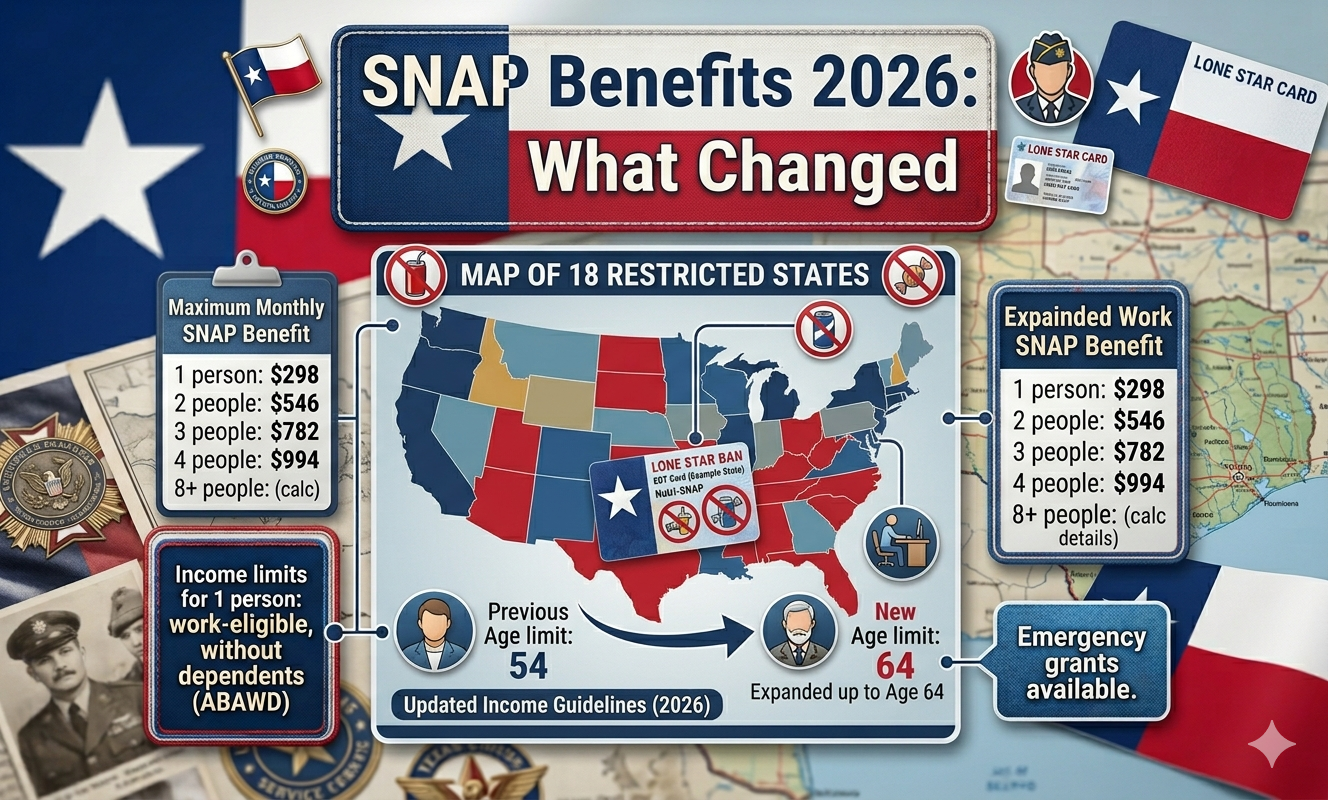
Your EBT food stamp balance is the amount of SNAP benefits loaded onto your Electronic Benefit Transfer card each month. You can check your balance by calling the number on the back of your card, using your state’s EBT app or website, checking your last grocery receipt, or visiting an ATM. SNAP benefits for 2026 range from $298 per month for one person to $994 for a family of four.
Recertification every 6–36 months; periodic reports required
Available States
All 50 states, Washington D.C., and U.S. territories
Last Updated
October 2026
What Is EBT?
EBT stands for Electronic Benefit Transfer. It is the system that delivers SNAP food stamp benefits electronically to a debit-style card you use at grocery stores and retailers.
Before EBT, SNAP benefits were issued as paper food stamps. Today, all SNAP benefits are delivered through EBT cards. The card works like a debit card: your monthly benefit amount is loaded onto the card, and you swipe it at the point of sale to pay for eligible food items.
Each state operates its own EBT system. Your EBT card may be called different names depending on your state:
Your EBT card is separate from other benefits. If you receive TANF cash assistance, those funds may also be loaded onto the same card or a separate card, depending on your state’s system. SNAP benefits and cash benefits are kept in separate “buckets” on your card, and SNAP benefits can only be used for eligible food items.
How to Check Your EBT Food Stamp Balance
You can check your EBT balance in several ways: by phone, online, through a mobile app, on your last receipt, or at an ATM.
Method 1: Call the Number on the Back of Your Card
This is the fastest and most reliable method. Every EBT card has a customer service number printed on the back. Call that number, enter your card number and PIN, and the automated system will tell you your current balance.
State
EBT Customer Service Number
New York
1-888-328-6399
California
1-877-328-9677
Texas
1-800-777-7328
Florida
1-888-356-3281
Illinois
1-800-678-5465
Pennsylvania
1-888-328-7366
Ohio
1-866-386-3071
Michigan
1-888-678-8914
Wait times can be long during peak hours (early morning and early in the month). Try calling mid-afternoon or mid-month for faster service.
Method 2: Use Your State’s EBT Website or App
Most states provide online balance checking through a website or mobile app.
To check your balance online, you typically need to create an account with your card number and personal information. Once logged in, you can view your current balance, transaction history, and deposit schedule.
Method 3: Check Your Last Grocery Receipt
Every time you use your EBT card at a grocery store, the receipt shows your remaining balance at the bottom. This is often the easiest way to keep track of your balance without making a phone call.
Method 4: Visit an ATM
Some EBT cards allow you to check your balance at an ATM, though this varies by state. Check your cardholder agreement to see if ATM balance inquiries are available in your state. Note that some ATMs may charge a fee for balance inquiries, and you may not be able to withdraw cash unless you receive cash benefits (TANF) on your card.
Most states use BBCE, which raises the gross income limit from the federal minimum of 130% FPL to 200% FPL. Nine states use the 130% limit.
2026 Gross Monthly Income Limits
Household Size
130% FPL (Federal)
200% FPL (BBCE States)
1
$1,696
$2,608
2
$2,292
$3,525
3
$2,888
$4,442
4
$3,483
$5,359
5
$4,079
$6,275
6
$4,675
$7,192
7
$5,271
$8,109
8
$5,867
$9,025
Net Income Limits (100% FPL)
Household Size
Maximum Net Monthly Income
1
$1,215
2
$1,644
3
$2,072
4
$2,500
5
$2,927
6
$3,355
7
$3,782
8
$4,210
Deductions That Lower Your Net Income
Deduction
2026 Amount
Standard deduction (1–3 persons)
$217
Standard deduction (4 persons)
$229
Standard deduction (5 persons)
$268
Standard deduction (6+ persons)
$307
Earned income deduction
20% of earned income
Dependent care deduction
Actual costs up to limits
Medical deduction (60+ or disabled)
Expenses over $35/month
Excess shelter deduction
Amount over 50% of net income
Asset Limits
Asset limits apply to SNAP unless your household is categorically eligible through BBCE.
Household Type
Resource Limit
No member 60+ or disabled
$2,750
Member 60+ or disabled
$4,250
BBCE-eligible households
No asset limit
What counts as a resource:
Cash and bank accounts
Stocks, bonds, and mutual funds
Vehicles (only equity above $4,650 counts)
What does NOT count:
Primary residence
Retirement accounts (if inaccessible)
Educational accounts
One vehicle per adult (up to $4,650 equity)
Household goods and personal effects
Household Requirements
Your SNAP household includes everyone who lives together and purchases and prepares food together.
Person
Counted in Household?
Yourself
Yes
Spouse
Yes
Children under 22 living with parents
Yes
Other relatives who purchase/prepare food together
Yes
Roommates who purchase/prepare food together
Yes
Roommates who purchase/prepare separately
Generally no
Boarders
Generally no
Special rules:
Students: Most able-bodied students ages 18–49 enrolled at least half-time in college are not eligible unless they meet an exemption
Seniors and people with disabilities: May have separate household status if they cannot purchase and prepare food with others
Spouses: Must be in the same household regardless of purchase/prepare arrangements
Citizenship and Immigration Rules
You must be a U.S. citizen or qualified immigrant to receive SNAP benefits.
Status
SNAP Eligibility
U.S. citizen
Eligible
Lawful permanent resident (5+ years)
Eligible
Lawful permanent resident (<5 years)
Generally ineligible
Refugee/Asylee
Eligible immediately
Cuban/Haitian entrant
Eligible
COFA resident
Eligible
DACA recipient
Ineligible
Undocumented
Ineligible
Mixed-status families: Eligible family members can receive SNAP even if other members are ineligible. For example, a U.S. citizen child can receive SNAP even if their undocumented parent cannot.
State Differences
SNAP is a federal program, but states have flexibility in certain areas.
Feature
Variation Across States
BBCE
42 states use 200% FPL; 9 states use 130% FPL
Standard deduction
Uniform federal amounts
Minimum benefit
$25 for 1–2 person households (federal minimum)
EBT issuance
Spread over first 9–14 days of month (varies)
Expedited processing
7 days (federal requirement)
Summer EBT
Available in most states; $120 per eligible child
Online purchasing
Available in most states through participating retailers
Required Documents
You will need specific documents to apply for SNAP.
Standard SNAP applications are processed within 30 days. Expedited applications are processed within 7 days.
Processing Type
Timeframe
Who Qualifies
Standard
30 days
Most applicants
Expedited
7 days
Households with very low income or high expenses
Who qualifies for expedited processing:
Households with gross monthly income less than $150 and liquid resources less than $100
Households with gross income plus liquid resources less than monthly rent plus utilities
Households experiencing homelessness
Migrant or seasonal farm workers with very low income
Payment Schedule
SNAP benefits are loaded onto your EBT card monthly, generally over the first 9–14 days of the month.
How benefits are issued:
Benefits are spread over several days based on your case number or the last digit of your Social Security number, depending on your state.
State
Issuance Schedule
New York
First 9 days of month (based on case number)
California
First 10 days of month (based on case number)
Texas
First 10 days of month (based on EDG number)
Florida
First 14 days of month (based on case number)
Illinois
First 10 days of month (based on case name)
Pennsylvania
First 10 business days of month
Payment method: Benefits are loaded onto your EBT card and can be used at authorized retailers. You can also use your EBT card for online grocery purchases at participating retailers including Amazon, Walmart, and Instacart.
Renewal Process
You must recertify before your certification period ends to continue receiving SNAP benefits.
Certification periods:
Household Type
Certification Period
Most households
12 months
Households with all members 60+ or disabled
Up to 24 months
Some households
Up to 36 months
Recertification process:
Receive your recertification notice — Sent before your certification period ends
Complete the recertification application — Online, by phone, or by mail
Complete an interview — Required for recertification
Submit required documents — Proof of income, expenses, and household composition
Receive a decision — Continued benefits or termination
What happens if you miss your deadline: Your benefits will close. You may be able to reactivate your case within a certain timeframe. Contact your local office immediately if you miss your recertification deadline.
Reasons Benefits Are Denied
The most common reasons for SNAP denial are income above limits, failure to complete the interview, and missing documents.
Reason
Explanation
Income above limit
Gross income exceeds 200% FPL (or 130% if not BBCE eligible)
Net income above limit
Income after deductions exceeds 100% FPL
Resources above limit
Resources exceed $2,750 (or $4,250 for 60+/disabled)
Failure to complete interview
Did not complete the required eligibility interview
Missing documents
Did not provide required verification
Immigration status
Not a U.S. citizen or qualified immigrant
ABAWD non-compliance
Failed to meet 80-hour monthly work requirement
Student ineligibility
Enrolled half-time+ without qualifying exemption
Appeals Process
If your SNAP application is denied or your benefits are reduced or terminated, you have the right to appeal.
How to appeal:
Request a fair hearing — Online, by phone, or by mail
Deadline — Within 90 days of the notice date (10 days for continued benefits)
Prepare for the hearing — Gather documents and evidence
Attend the hearing — Conducted by phone or in person
Receive a decision — Written decision issued after the hearing
Continuation of benefits: If you appeal before your benefits are scheduled to change or stop, you can request continuation of benefits at the same level until the hearing decision.
Common Mistakes
Avoid these common mistakes to protect your SNAP benefits:
Not reporting changes — Report income, household, and address changes within 10 days
Missing recertification deadlines — Mark your calendar and complete recertification on time
Not completing the interview — The interview is required
Missing documents — Submit all required verification documents
Not checking your EBT balance — Know how much you have before shopping
Sharing your PIN — Never share your EBT card or PIN with anyone
Not reporting a lost or stolen card — Report immediately to prevent unauthorized use
Assuming you make too much — BBCE allows income up to 200% FPL in many states
Not applying because of immigration status — Eligible family members can receive benefits
Not appealing a denial — You have the right to appeal
Recent Changes
Several significant changes affect SNAP in 2026:
Benefit increase (October 1, 2025): Maximum SNAP benefit amounts increased for FY2026. A family of four can now receive up to $994/month.
Standard deduction increase: Standard deductions increased to $217 for 1–3 person households, $229 for 4-person households, $268 for 5-person households, and $307 for 6+ person households.
ABAWD work requirements expanded: The age range for ABAWDs expanded from 18–54 to 18–64. The childcare exemption narrowed to children under 14.
Summer EBT: $120 per eligible child issued in most states beginning June 2026.
Federal administrative cost shift: The federal government reduced its share of SNAP administrative costs from 50% to 25%, forcing states to shoulder more of the cost.
Frequently Asked Questions
How do I check my EBT food stamp balance?
Call the number on the back of your EBT card, use your state’s EBT app or website, check your last grocery receipt, or visit an ATM. The fastest method is calling the customer service number on your card and entering your card number and PIN.
Maximum monthly SNAP benefits for 2026: $298 for one person, $546 for two, $844 for three, $994 for four, $1,183 for five, $1,421 for six, $1,571 for seven, and $1,789 for eight. Households of 18 or more can receive up to $3,887.
What is the income limit for SNAP?
In BBCE states, gross monthly income up to 200% FPL qualifies. For a family of four, that’s $5,359/month. For one person, $2,608/month. Households must also meet the net income test (100% FPL) after deductions.
How long does it take to get SNAP benefits?
Standard applications are processed within 30 days. Expedited applications are processed within 7 days. Apply as soon as possible and complete your interview promptly to avoid delays.
What can I buy with SNAP benefits?
SNAP can be used for breads, cereals, fruits, vegetables, meats, fish, poultry, dairy products, and seeds and plants that produce food. You cannot buy alcohol, tobacco, hot prepared foods, pet food, or non-food items.
Can I use my EBT card online?
Yes. You can use your EBT card for online grocery purchases at participating retailers including Amazon, Walmart, and Instacart. Not all retailers accept EBT online, so check before ordering.
What is the ABAWD work requirement?
ABAWDs are Able-Bodied Adults Without Dependents ages 18–64. Starting March 1, 2026, ABAWDs must document 80 hours/month of work, education, or volunteering to maintain SNAP benefits. Exemptions include pregnancy, disability, and caring for someone who cannot care for themselves.
Can college students get SNAP?
Most able-bodied students ages 18–49 enrolled at least half-time are not eligible. However, students may qualify if they work at least 20 hours/week, participate in work-study, care for a child under 6, receive TANF, or meet other specific exemptions.
Can immigrants get SNAP?
U.S. citizens, lawful permanent residents (after 5 years), refugees, asylees, Cuban/Haitian entrants, and COFA residents may qualify. Undocumented immigrants and DACA recipients are not eligible. Eligible family members can receive benefits even if other members are ineligible.
When are SNAP benefits deposited?
Benefits are loaded over the first 9–14 days of the month, depending on your state and case number. Benefits are loaded onto your EBT card and can be used immediately.
What happens if I miss my recertification?
Your benefits will close. You may be able to reactivate your case if you complete the recertification requirements within a certain timeframe. Contact your local office immediately if you miss your deadline.
How do I report a lost or stolen EBT card?
Call your state’s EBT customer service number immediately to report a lost or stolen card. You can also report it through your state’s EBT app or website. Once reported, your card will be deactivated and a new one issued. Federal law requires states to replace stolen SNAP benefits in certain circumstances.
What is Summer EBT?
Summer EBT is a program that provides $120 per eligible child to help families buy food during the summer when school meals are unavailable. Children who receive free or reduced-price school meals are generally eligible.
Can I check my EBT balance without my card?
No. To check your balance by phone or online, you need your EBT card number and PIN. If you have lost your card, call customer service to request a replacement.
Why is my EBT balance lower than expected?
Your balance may be lower than expected if: you have pending transactions, your benefits were prorated for the first month, your household size or income changed, or you have an overpayment being recovered. Contact your state agency if you have questions about your balance.
Key Takeaways
EBT is the system that delivers SNAP benefits electronically to a debit-style card
Check your balance by phone, online, through a mobile app, or on your last receipt
Maximum SNAP benefits for 2026: $994/month for a family of four; $298 for an individual
Most states use BBCE with a 200% FPL gross income limit
Apply online through your state’s portal; expedited processing available within 7 days
Benefits are deposited over the first 9–14 days of each month
Recertification is required to maintain benefits; certification periods range from 6 to 36 months
ABAWD work rules expanded to ages 18–64 effective March 2026
Eligible immigrants can receive SNAP; mixed-status families can apply for eligible members
Report a lost or stolen EBT card immediately to prevent unauthorized use
SSI Payment Date September 2026: When You Get Your Check Quick Answer The Supplemental Security Income (SSI) payment for September 2026 will be issued on Tuesday, September 1, 2026. This is a standard first-of-the-month payment date because September 1 falls on a regular business day (Tuesday). If you are currently receiving SSI benefits, your payment will…
Introduction to Alabama Food Stamps (SNAP) The Supplemental Nutrition Assistance Program (SNAP), commonly known as Alabama Food Stamps, is a federal assistance program aimed at helping individuals and families achieve food security. It provides essential nutritional assistance to low-income residents of Alabama, allowing them to purchase food and maintain a healthy diet. The program plays…
Introduction to Summer EBT Benefits The Summer Electronic Benefits Transfer (EBT) program serves as a vital resource designed to support families facing food insecurity during the summer months when school meal programs are suspended. This initiative not only offers financial assistance to eligible families but also plays a crucial role in ensuring that children have…
Introduction to the Arkansas EBT Card The Arkansas EBT (Electronic Benefits Transfer) card is a fundamental resource designed to assist low-income individuals and families in accessing essential food items. This card acts as a modern counterpart to traditional food assistance programs, streamlining the process of purchasing necessary groceries through a convenient electronic format. Each Arkansas…